


Since our modern kitchen already operates in a DevOps model,where automated pipelines (CI/CD) ensure the rapid preparation and delivery of successive portions of code, we now need to move on to the stage that defines every restaurant’s reputation: tasting and quality control. In the IT world, this stage is known as software testing, and it is the absolute lifeline of any system.
Quality Control – Why You Should Never Serve “Raw” Code
In every good kitchen, there is one fundamental rule: before a dish reaches the guest, it must be tasted. In the world of software, this role is played by testing—a stage that ensures the “dish” meets expectations and contains no hidden defects.
Ignoring this rule can lead to disaster. In 2000, the Y2K problem was caused by a minor date-formatting flaw, which led some computer systems to interpret the year 2000 as… 1900. The result? Some ATMs stopped working, airline systems had to be checked manually, and major power plants prepared for emergency shutdowns.
In 2008, at the Royal Bank of Scotland, a single error in the payment system blocked 600,000 transfers. Customers were unable to move their money, the bank lost trust, and the penalty amounted to… 66 million pounds.
And Yahoo? In 2013, a lack of security testing led to a data breach affecting 500 million accounts. It’s as if the kitchen allowed all the ingredients to spill into the water—a complete loss of control.
That’s why in our “IT kitchen” we follow a simple rule: test first, serve later. It’s better to catch an issue during preparation than to let the “customer” discover it at the table.
The Foundation of the Dish: The Test Automation Pyramid
Now that we understand how dangerous “burnt dishes” can be, it’s time to learn how to prepare code so that every element is just right. A good chef doesn’t check a dish only once before serving—they monitor quality at every stage of the cooking process. Developers do exactly the same, except instead of tasting, they rely on tests. And just like in the kitchen, there’s a hierarchy: the higher the level of verification, the more expensive, slower, and less frequently it is used.
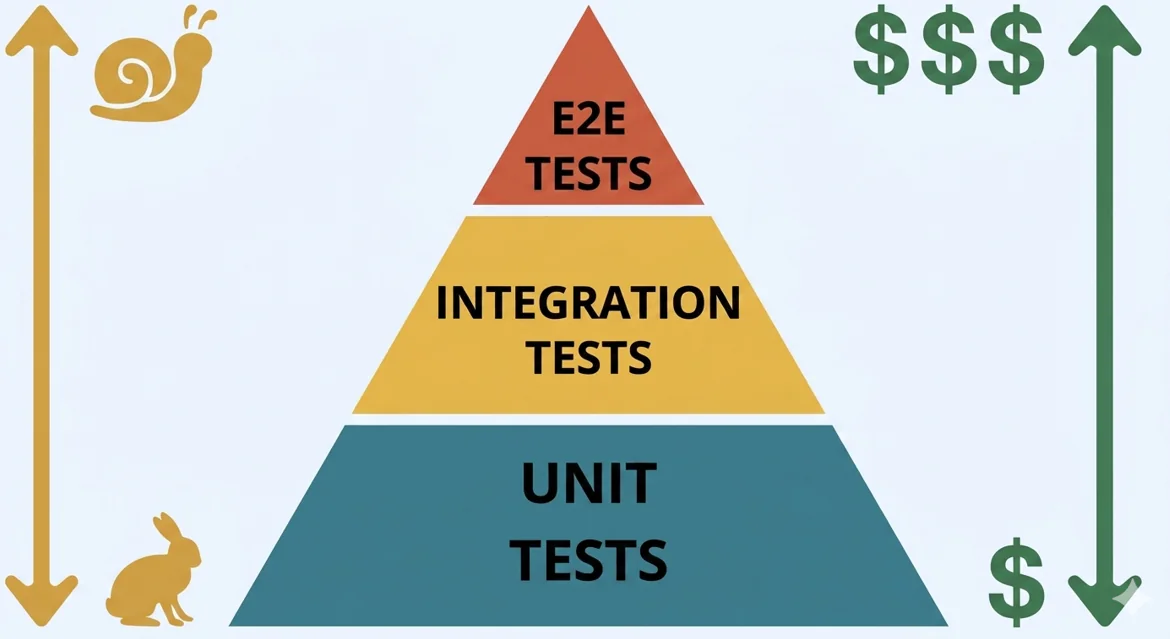
- Unit tests -verify individual functions in isolation, like assessing each ingredient before cooking. They must be fast, numerous, and reliable. A test you don’t trust is useless.
- Integration tests -verify whether modules work together correctly. Excellent ingredients on their own don’t guarantee a great dish – the flavors have to come together.
- End-to-end (E2E) -tests simulate a real user: clicking, filling out forms, and browsing results. They are the slowest and most expensive, so they are used the least. They answer one key question: “Can the user accomplish what they came here to do?”
The test pyramid is not just a technical convention – it’s a philosophy of responsibility for code that reaches real people. The stronger your foundation of unit tests, the more confidently you can build the higher layers – and the more peacefully you can sleep before every release.
Menu Classification: What Do We Test?
Now that our “kitchen” has a solid foundation and every ingredient has been checked, it’s time to look at how the dish tastes and whether it satisfies the guest. In testing, we distinguish two main tracks—one focused on what the dish does, and the other on how it feels to the user.
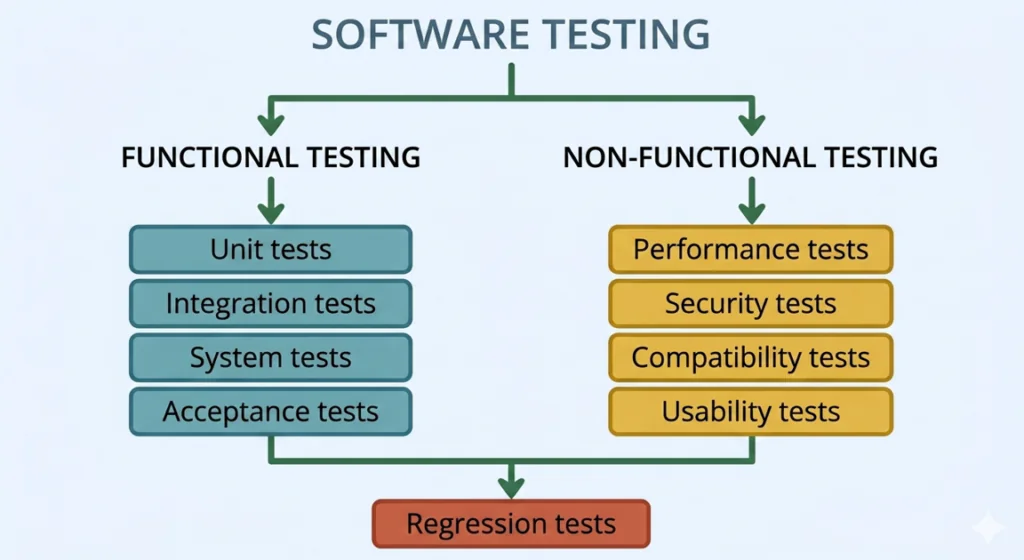
Functional Testing: Does the Dish Deliver on Its Promise?
Here, we verify whether the recipe works as expected. Does clicking “Search” actually display the recipe? It’s like making sure the ordered dessert reaches the table in the right form and at the right temperature.
- Smoke Testing: A quick check to ensure the “kitchen isn’t on fire” and that the core functionalities are working. If something fails here, there’s no point in proceeding with further tests.
- Regression Testing: A new seasoning shouldn’t ruin the dishes we’ve already prepared. We verify that adding a new feature hasn’t broken what was previously working perfectly.
Non-Functional Testing: How Does the Dish Taste?
This is the point where we focus not on what the dish does, but on how it is experienced by the guests:
- Performance (Load): Can the kitchen handle a thousand guests at once, for example during a “Big Sale”?
- Security: Is the pantry storing customer data securely locked against prying guests and hackers?
- Usability: Is the menu clear, and can the guest navigate without getting lost among tables and shelves?
Thanks to this classification, we can ensure that our “dishes” not only work as intended but also deliver the right experience – regardless of the number of guests or the complexity of the recipe.
Kitchen Hygiene: Linting and Static Analysis
Before you even start cooking, make sure your kitchen is clean. This is where the Linter comes in — your digital sous-chef. It reviews your “recipe” (code) line by line, catching stylistic issues, typos, and unused ingredients (variables) before anything hits the stove.
With it, you can avoid small but frustrating mistakes that could spoil the entire dish. Linting is the cheapest and fastest way to keep your kitchen in order and make sure every ingredient is in its proper place before the real cooking begins.
Modern Technology: AI as Your “Robo-Sous-Chef”
In a modern developer’s kitchen, you’re not alone – Artificial Intelligence steps in as your digital sous-chef, capable of significantly speeding up the preparation of perfect dishes.
- Self-healing: If you change a “button ID” in the menu, AI automatically updates your test scripts. It’s like a kitchen robot adjusting the seasoning proportions on its own so the dessert still tastes perfect—without your intervention.
- Data generation: AI can rapidly produce thousands of realistic “orders” to test the system under extreme conditions. Imagine trying to serve hundreds of guests at once-with AI, you can verify whether the kitchen can handle the pressure before letting in real customers.
With tools like these, your QA kitchen becomes more predictable, efficient, and resilient to surprises – and you can focus on creating new, delightful dishes instead of fixing errors.
Glossary of “Kitchen Mishaps”
In a QA kitchen, it’s important that everyone understands exactly what went wrong. Here are the most common “mishaps” your dishes might encounter:
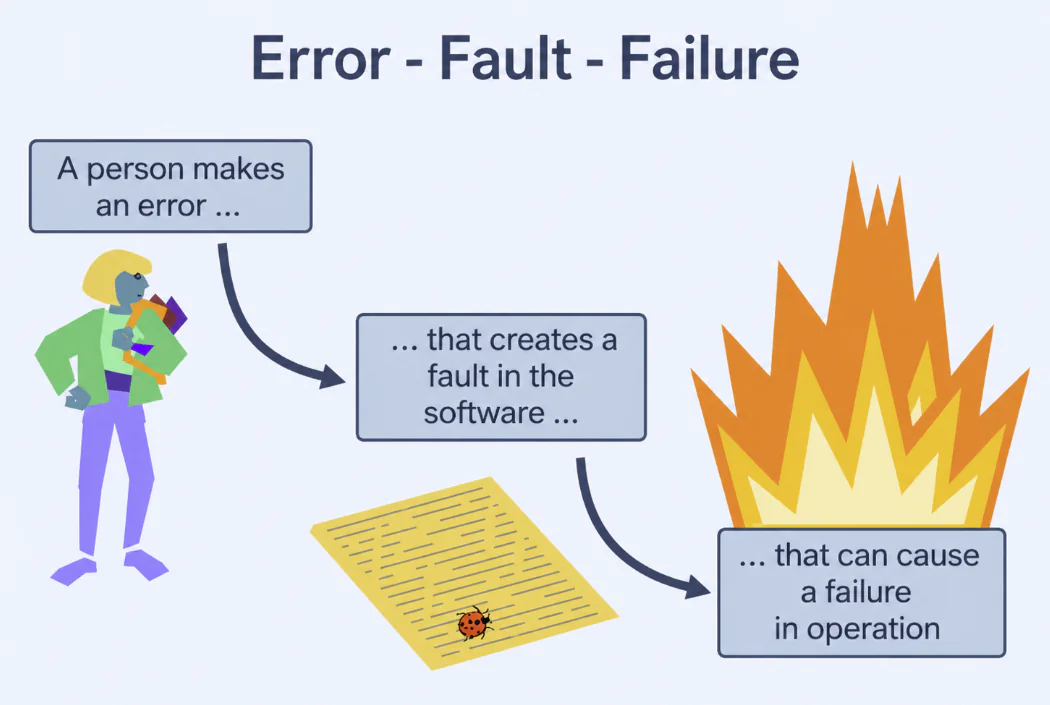
- Error – a cook’s mistake: a moment of inattention while writing the recipe. For example, a typo in an ingredient name or forgetting to add a pinch of salt.
- Fault / Defect – a hidden flaw in the recipe: an issue that arises from a cook’s mistake but hasn’t yet manifested in the final dish. For example, an incorrect baking time or improper temperature-something that can ruin the end result.
- Failure – an unsatisfactory dish for the guest: the moment when the guest experiences the effect of an error. The dessert collapses, the sauce separates, and the customer realizes something has gone wrong. It is the manifestation of a defect in a running application – the fully visible outcome of a hidden flaw.
Thanks to this terminology, the entire team knows what is being fixed and at which stage, before the problem reaches the customer’s table.
Summary
Exceptional software, like a fine dish, is created only when every ingredient is carefully selected and the process is refined down to the smallest detail. Testing is not an add-on or a final step – it is continuous tasting and adjustment at every stage, allowing imperfections to be caught before they reach the guest.
Intelligent tools, such as automation and artificial intelligence, support the chef by eliminating repetitive errors and preparing test data, but it is human taste, creativity, and attention to user experience that ultimately determine whether the dish delights. The true judge is always the end user – even a perfect recipe can fail if it does not meet their expectations.
Following these principles turns testing from an obligation into a strategic advantage – it protects against mishaps, financial losses, and reputational damage, enabling the creation of products that deliver a flawless experience and stay in users’ minds for a long time.
Now that our “kitchen” has a solid foundation and every ingredient has been checked, it’s worth considering who can use it and how. With authentication and authorization in place, every recipe goes exactly where it should – no one can access someone else’s recipe or modify it accidentally. And since the kitchen is now in order, we can move on to the next stage – user handling and managing access to our digital recipes.
Materials
Self-study materials that are related to this topic:
- Software testing basics
- Generative AI in software testing
- What is linting
- Linter configuration
- Different types of software testing
- How to create and run automated test scripts
- Self-healing automation using AI
- Software testing: bug vs defect vs error vs fault vs failure
- Requirements-based software testing
- Software testing
- What is test automation
- QA in Agile
- What is a linter and why you should use it
- Types of software testing